
Business requirements are about more than choosing the right words. A requirement can sound clear and still create problems if the team has not fully understood the business need or made the decisions required to move forward.
Strong business requirements start with the work that happens before they are written. Teams need to understand the problem, determine what needs to change, resolve important questions, and then turn that understanding into requirements people can use.
Why Are Requirements Often Unclear?
Teams sometimes begin writing requirements too early. A stakeholder describes what they want, and the team immediately starts documenting features, functions, or solution details. The problem is that important questions may still be unanswered.
Stakeholders may have different expectations. The team may not fully understand the current process or what needs to change. Important decisions about ownership, access, priorities, or desired outcomes may still need to be made. When those issues remain unresolved, they often show up later as unclear or changing requirements.
This can lead to requirements that:
- Leave room for different interpretations
- Change after work has already begun
- Combine several needs into one statement
- Cannot be easily tested
- Do not clearly connect to the original business need
Before improving the wording of a requirement, make sure the thinking behind it is clear.
Start With the Business Problem
Before asking what a solution needs to do, understand why the work is needed. Stakeholders often arrive with a solution already in mind, but that solution may not tell you what problem actually needs to be solved.
For example, a stakeholder might say, “We need a new reporting dashboard.” Before turning that request into requirements, ask why. Leaders may not be able to access information quickly enough. Reports may contain inconsistent data. Employees may be spending hours gathering information manually. Each of those problems could lead to very different requirements.
Understanding the underlying business problem gives the requirements a purpose. It also helps prevent the team from building exactly what was requested only to discover that it does not solve the original problem.
Understand What Needs to Change
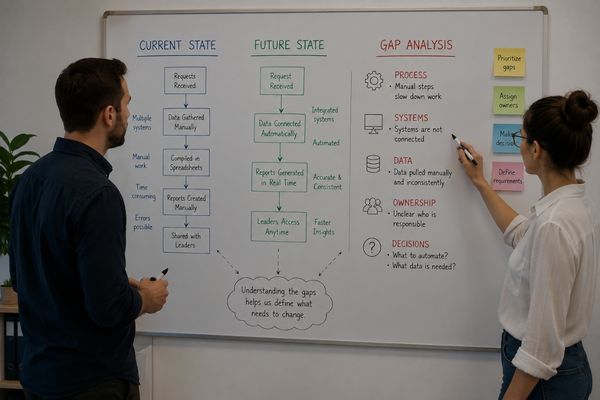
Requirements should not appear out of nowhere. Before writing them, the team should understand what is happening today, what should be different in the future, and what is preventing that future state from becoming reality.
Suppose employees currently spend several hours each week manually combining information from different systems. The desired future state might be that leaders can access consistent, up-to-date information without employees manually compiling it. That gives the team much more context than simply starting with “build a dashboard.”
Understanding the current and future states helps clarify the outcome the organization is trying to achieve. The team can then use gap analysis to identify what needs to change between those states. Those gaps may involve processes, systems, data, ownership, or unresolved decisions.
Make Important Decisions Before Writing Requirements
Sometimes what looks like a requirements problem is actually an unresolved decision.
Imagine a team is writing requirements for a new request process. They know users need access to request information, but nobody has decided which users should be able to see which information. The person writing the requirement could make an assumption, but that assumption may turn out to be wrong later.
Instead, the team should identify the decision and get it resolved by the appropriate person. Common questions that may need decisions include:
- Who should have access?
- Who owns the process?
- What information is required?
- Which business rules should apply?
- Which option should the organization pursue?
Resolving those questions first creates a stronger foundation for requirements. It also prevents the person writing them from quietly making business decisions they may not have the authority to make.
Connect Requirements to Business Decisions
A useful requirement should have a reason to exist. The team should be able to explain what business need, gap, or decision led to that requirement.
For example, suppose leadership decides that managers need to see the status of all requests assigned to their department. A requirement can then describe what capability is necessary to support that decision. The requirement is no longer an isolated statement. It has a clear business reason behind it.
This connection also helps when requirements change. Instead of accepting a change simply because someone requests it, the team can examine whether the underlying business need or decision has changed. If it has not, there may be a reason to question whether the requirement should change at all.
Maintaining a clear connection between requirements and the business need behind them can also make requirements easier to evaluate and manage as work changes. The IIBA BABOK glossary defines requirements traceability as a way to track the relationships between requirements and designs from the original stakeholder need through to the implemented solution.

FREE GUIDE
Turn Vague Requests Into Clear Requirements
Download our free Business Analysis Six-Step Framework Guide for a practical path from understanding the problem to writing clear requirements.
Four Tests for Clear Business Requirements
Once the necessary analysis and decisions have been completed, the wording matters. A useful way to review clear requirements is to check them against four basic tests.
1.) Clarity:
Could two people read the requirement and understand it the same way?
Words such as easy, fast, flexible, or user-friendly may sound helpful, but they can mean different things to different people. Replace vague language with something specific enough for the team to understand what is expected.
2.) Testability:
Can someone determine whether the requirement has been met? Testable requirements give the team a way to verify the expected result. If nobody can determine whether the requirement has been satisfied, it probably needs additional clarification.
3.) Completeness:
Does the requirement contain enough information for someone to understand what is expected?
A requirement does not need to contain every implementation detail, but it should not force the reader to make important assumptions about the business need.
4.) Atomicity:
Does the requirement describe one thing?
When several expectations are combined into one requirement, it becomes harder to understand, implement, test, and change. Breaking them apart can make each requirement easier to manage.
These four tests provide a simple way to review requirements before they become the basis for additional work.
What Does a Clear Requirement Look Like?
Consider a vague requirement such as: “The system should make it easy for customers to check their requests.”
The word easy is open to interpretation, and the statement does not clearly explain what customers actually need to see.
A clearer version might be: “Customers must be able to view the current status and next step for each request they have submitted.”
The second version gives the team a more specific expectation and provides a better starting point for determining whether the requirement has been met.
The goal is not to make every requirement longer or more technical. In many cases, clear requirements are actually simpler because unnecessary language and assumptions have been removed.
Test Your Requirements Before Moving Forward
Strong business requirements should be reviewed before they become the basis for development or other work. This does not need to be a long, formal review. A short conversation with the right stakeholders can uncover different interpretations, missing information, and unanswered questions before they become bigger problems.
Ask:
- Could someone interpret this differently?
- How will we know when it has been met?
- Is important information missing?
- Are several requirements combined into one?
- Can we explain why this requirement exists?

If those questions reveal uncertainty, address it before moving forward. A few minutes spent clarifying a requirement can prevent much more time being spent correcting assumptions later.
Strong Business Requirements Start Before the Writing
Strong business requirements are not the result of finding the perfect template or sentence structure. They are the result of clear thinking.
Teams first need to understand the business problem, examine how work happens today, determine what needs to change, identify important gaps, and resolve the decisions that affect the work. Requirements can then capture what is needed in a way that people can understand, use, and verify.
When that work happens before requirements are written, teams are less likely to rely on assumptions or discover major misunderstandings after work has already begun.
Build Stronger Skills

Business Analysis Essentials is a hands-on business analysis workshop for technical professionals who want a practical way to bring clarity and structure to business problems before jumping to solutions.
Participants practice understanding current and future states, identifying gaps, making key decisions, creating clear requirements, and strengthening stakeholder and leadership conversations.
Learn more about our Business Analysis Training for Technical Teams.

Tagged with: Requirements Gathering, Requirements Writing, Stakeholder Alignment