
Current state vs future state analysis helps teams understand where they are today, where they need to go, and what needs to change along the way. It sounds simple, but teams often skip this thinking. A business problem is identified, and the conversation quickly shifts to what should be built, purchased, automated, or changed. The problem is that choosing a solution before understanding the current situation can lead to decisions based on assumptions.
Business analysis creates an opportunity to slow down the decision, not the work. By understanding the current state and defining a realistic future state, teams have a stronger foundation for deciding what actually needs to change and which solutions are worth considering.
What Is the Current State?
The current state describes how work actually happens today, which may be different from how the process is documented. A process might look simple on paper, but in reality, employees may use spreadsheets outside the official system, send emails to work around slow approvals, skip steps that no longer make sense, or rely on one person who knows how everything works.
A useful current state analysis looks beyond the official process to understand what is really happening. It examines how work moves from beginning to end, who is involved, where decisions happen, what systems are used, and where people experience delays, confusion, or frustration.
When exploring the current state, pay particular attention to:
- Roles and ownership
- Handoffs between people or teams
- Systems, tools, and data
- Delays and bottlenecks
- Workarounds and exceptions
- Points where decisions are unclear
The goal is not to document every detail. It is to understand enough about the current environment to explain why the problem exists and what may be contributing to it.
Creating a visual process map can be useful here because it makes the flow of work, responsibilities, handoffs, and potential bottlenecks easier to see.
The process map below shows a customer refund moving across three groups: Customer, Support, and Finance. The customer requests a refund, Support logs the request and can approve refunds under $50. Larger refunds move to Finance for review. Finance checks whether the required documentation is complete; if it is, the refund is issued. If not, the request loops back to Support for additional information.
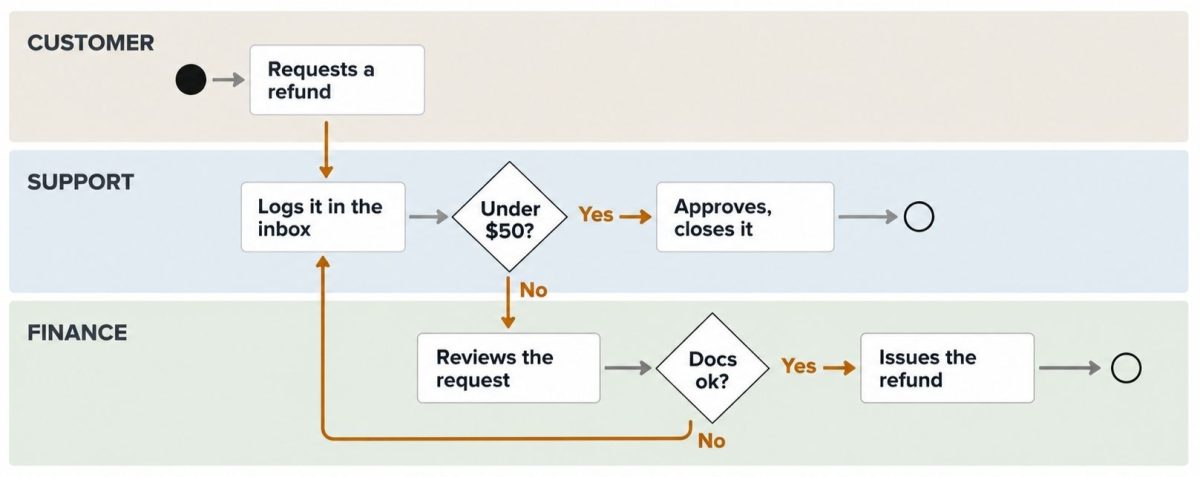
What readers should notice is that the map shows how the work moves between people and teams, not just the ideal sequence of steps. The swimlanes make ownership and handoffs visible, while the decision points reveal where different paths can occur. Most importantly, the return from Finance to Support exposes rework: incomplete documentation causes the request to move backward through the process. Mapping the current state this way can reveal delays, unclear ownership, unnecessary handoffs, and other problems that may be difficult to see when a process is described only in words.
The Official Process vs. the Real Process

One of the most useful questions during current state analysis is simply: What actually happens? Imagine an organization says its request process is straightforward: a request is submitted, reviewed, assigned, completed, and closed. On paper, everything looks clear.
Talk to the people doing the work, however, and you may discover a very different process. Some requests arrive through email while others are entered into a system. Urgent requests may be sent directly to specific employees; ownership is not always clear, and stakeholders frequently ask for updates because they cannot see the status of their requests.
Once you understand what is really happening, the problem can look very different. The organization may not simply need a better request system. It may be dealing with inconsistent intake, unclear ownership, poor visibility, or several issues working together. Conversations with the people doing the work help uncover these differences and show how the process actually works in practice.
Why Does the Current State Matter?
When everyone agrees something is not working, spending time understanding the current state can feel unnecessary. Teams may think, “We already know this process is broken. Why spend more time studying it?” But knowing that something is broken is different from understanding why it is broken. A team may believe it needs new technology when the real problem is an unclear handoff between departments, or blame delays on employees when the process actually requires several approvals that provide little value.
If you skip the current state, those assumptions can follow you directly into the solution. You may improve the technology without improving the process or automate a process that should have been changed first. Understanding the current state helps teams look beyond the most visible symptoms, identify what is actually causing the problem, and make better decisions about what needs to change.
How Much Current State Analysis Do You Need?

There is another side to this. Current state analysis can become too detailed. You do not need to document every possible exception, create an enormous process map, or spend weeks gathering information that will never influence a decision. The amount of analysis should match the size and complexity of the problem.
A few questions can help keep the work focused:
- Does this information help us understand the problem?
- Does it reveal a pain point, dependency, or constraint?
- Could it affect a future decision?
- Does it help explain what needs to change?
If the information does not help answer those questions, you may not need it.
The purpose of current state analysis is clarity, not documentation for the sake of documentation.
What Is the Future State?
Once you understand where you are today, you can begin defining where you need to go. The future state describes what should be different once the business problem has been addressed. It gives the team a clear destination without requiring them to choose a specific solution yet. The IIBA Business Analysis Standard describes defining the future state as determining the necessary conditions needed to meet the business need.
For example, if customers currently have no way to see the status of a request, the future state might describe a process where customers can easily see the status and next step without specifying which technology should provide that visibility. A useful future state focuses on what needs to improve, such as how work flows, who owns important activities, what information is available, which pain points are reduced, and what a successful outcome looks like.
Without that clarity, teams can spend time improving individual parts of a process without knowing whether those changes are actually moving the organization toward the right outcome.
Future State Is Not the Same as a Solution
This is one of the most important distinctions in current state vs future state analysis. Imagine a stakeholder says, “We need a new ticketing system.” That may sound like a business need, but it is actually a proposed solution. Before accepting it, the team needs to understand what is not working today and what needs to improve.
Further discussion might reveal that requests are being lost, employees cannot tell who owns them, stakeholders cannot see their status, and managers cannot identify where requests are getting stuck. With that context, the future state could instead be described as: “Requests have clear ownership, visible status, and defined next steps that the appropriate people can easily access.”
Now the team has a much clearer picture of what needs to be different without deciding how to accomplish it. A new ticketing system might ultimately be the best option, but the team can evaluate that system against the desired outcome rather than assuming the solution has already been decided.
Make the Future State Specific Enough to Be Useful
A future state also needs to be more specific than “improve efficiency,” “create a better customer experience,” or “make the process easier.” Those statements describe good intentions, but they do not give the team a clear picture of what success looks like.
For example, instead of saying “improve the approval process,” the future state might describe a process with clear ownership, fewer unnecessary handoffs, visible status, and defined criteria for when additional approval is required. This gives the team a more specific outcome to work toward and a clearer way to determine whether the future state has been achieved.
A useful future state should help the team answer questions such as:
- What should work differently?
- What problems should no longer exist?
- Who should have clearer ownership?
- What information should be available?
- What would tell us the change was successful?
This gives the team something concrete to compare against today’s reality.
Keep the Future State Realistic
A future state does not mean a perfect state. Every organization has constraints, whether that means limited budgets, existing technology that needs to remain in place, regulatory requirements, limited team capacity, or dependencies outside the organization’s control. Those constraints should be part of the conversation when defining what the future should look like.
The goal is to define a future state that represents meaningful improvement while still being realistic enough to achieve.
Current State vs Future State: What’s the Difference?

The simplest way to think about current state vs future state is that one establishes your starting point and the other establishes your destination. The current state asks, “Where are we today?” while the future state asks, “Where do we need to be?” Neither is as useful on its own. The real value comes from comparing the two.
This future-state map builds directly on the current-state process shown earlier. Rather than redesigning everything, it highlights specific changes: required documentation is collected up front, intake is automatically logged and checked, and the customer is notified when the request is received. The rework loop for missing documentation can then be removed.
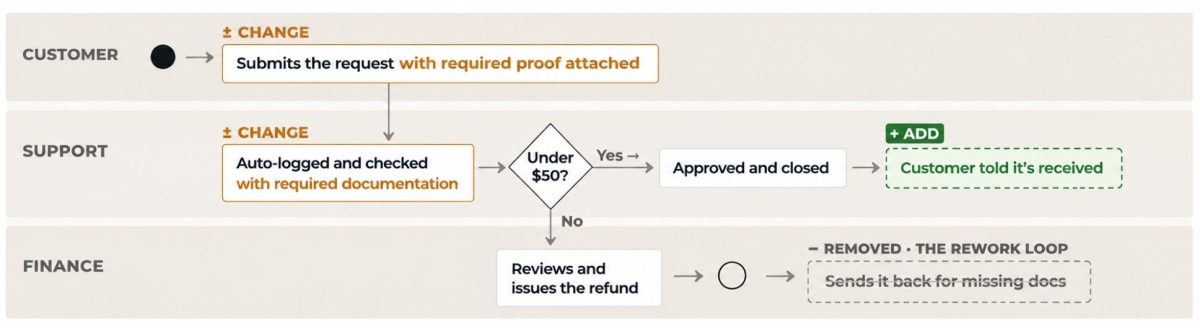
What readers should notice is that most of the process remains intact. The future state changes only what needs to change. Required documentation is collected earlier, intake is automatically logged and checked, and the customer receives confirmation that the request was received. Those targeted changes eliminate the rework loop without requiring the entire process to be redesigned.
Once the team understands both, the conversation can move away from broad statements such as “we need a better process” and toward identifying the specific things preventing the organization from reaching the desired outcome. Visualizing both states can also make those differences easier to see.
FREE GUIDE
Bring the Full Business Analysis Process Together
Current state and future state are two parts of a larger process. Get the free six-step guide to see how to move from an unclear request to clear requirements.
What Comes Next? Identify the Gaps
Once the current and future states are clear, the next question becomes: What is preventing us from getting from here to there? This is where gap analysis begins. For example, the current state might show that requests arrive through several different channels, ownership is often unclear, and stakeholders cannot easily see request status. If the future state calls for consistent intake, clear ownership, and better visibility, the differences between the two become much easier to identify.
These gaps might involve processes, systems, data, or people and ownership. Some may prevent the organization from reaching the future state entirely, while others may create risks or make the change more difficult. The goal is to move beyond a broad statement like “our process needs improvement” and identify specifically what needs to change to reach the desired future state.
Current and Future State Lead to Better Decisions
This analysis also changes the quality of the decisions teams make. Without it, the conversation may start with, “Which system should we buy?” With a clear understanding of the current and future states, the question becomes, “Which option best addresses the gaps between where we are and where we need to be?”
That gives stakeholders a stronger basis for comparing options and trade-offs. The same approach can be used when evaluating technology, process changes, automation, staffing, data needs, or changes in ownership. Instead of choosing an option because someone prefers it, the team can evaluate whether it actually addresses the identified gaps and moves the organization toward the future state.
From Current State to Clear Requirements
Current and future state analysis are not isolated activities. They are part of a larger business analysis process:
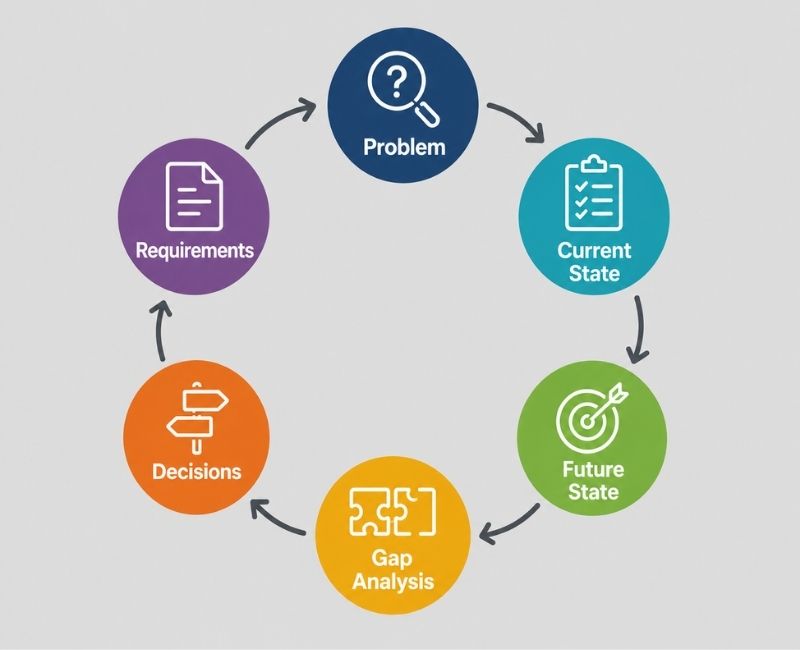
The problem establishes what needs attention. The current state provides the starting point, while the future state defines the desired outcome. Comparing the two reveals gaps. Those gaps often lead to decisions, and those decisions provide the foundation for requirements.
Following this sequence helps teams avoid jumping directly from a business request to a technical solution.
It also gives requirements context. Instead of writing a requirement simply because someone requested a feature, the team can connect that requirement back to a decision, a gap, a desired future state, and ultimately the business problem being solved.
A Current State vs Future State Example
Imagine a company is receiving complaints about how long customer requests take to resolve. The first reaction might be, “We need to automate the process.” Instead of jumping straight to that solution, the team examines the current state and discovers that requests arrive through several channels, ownership changes often, employees spend time figuring out who is responsible for the next step, and customers have little visibility into request status.
The team then defines the future state: requests should follow a consistent intake process, have clear ownership throughout the workflow, and provide appropriate status visibility from submission through resolution. Comparing the two states makes the gaps much easier to see. The organization may need to address intake, ownership, workflow, visibility, or technology. Automation may still be part of the solution, but the analysis helps prevent the team from assuming it is the entire answer.
That is the value of working through the thinking in sequence.
Create Clarity Before Choosing a Solution
Good business analysis is not about adding unnecessary steps or slowing teams down. It is about reducing uncertainty before significant time, money, and effort are committed to a solution. Current state vs future state analysis gives teams a clearer picture of what is happening today and what needs to be different moving forward.
From there, teams can make better decisions and develop clearer requirements based on what the organization actually needs rather than what someone initially assumed the solution should be.
Build Stronger Skills

Business Analysis Essentials is a hands-on business analysis workshop designed for technical professionals who need a practical way to work through business problems before jumping to solutions.
Participants practice moving through the complete process:
Problem → Current State → Future State → Gap Analysis → Decisions → Requirements
They also practice stakeholder conversations, decision-making, and communicating the information leaders need to move work forward.

Tagged with: Current State Analysis, Future State Analysis, Gap Analysis